“Sometimes, Bullying Is Okay”
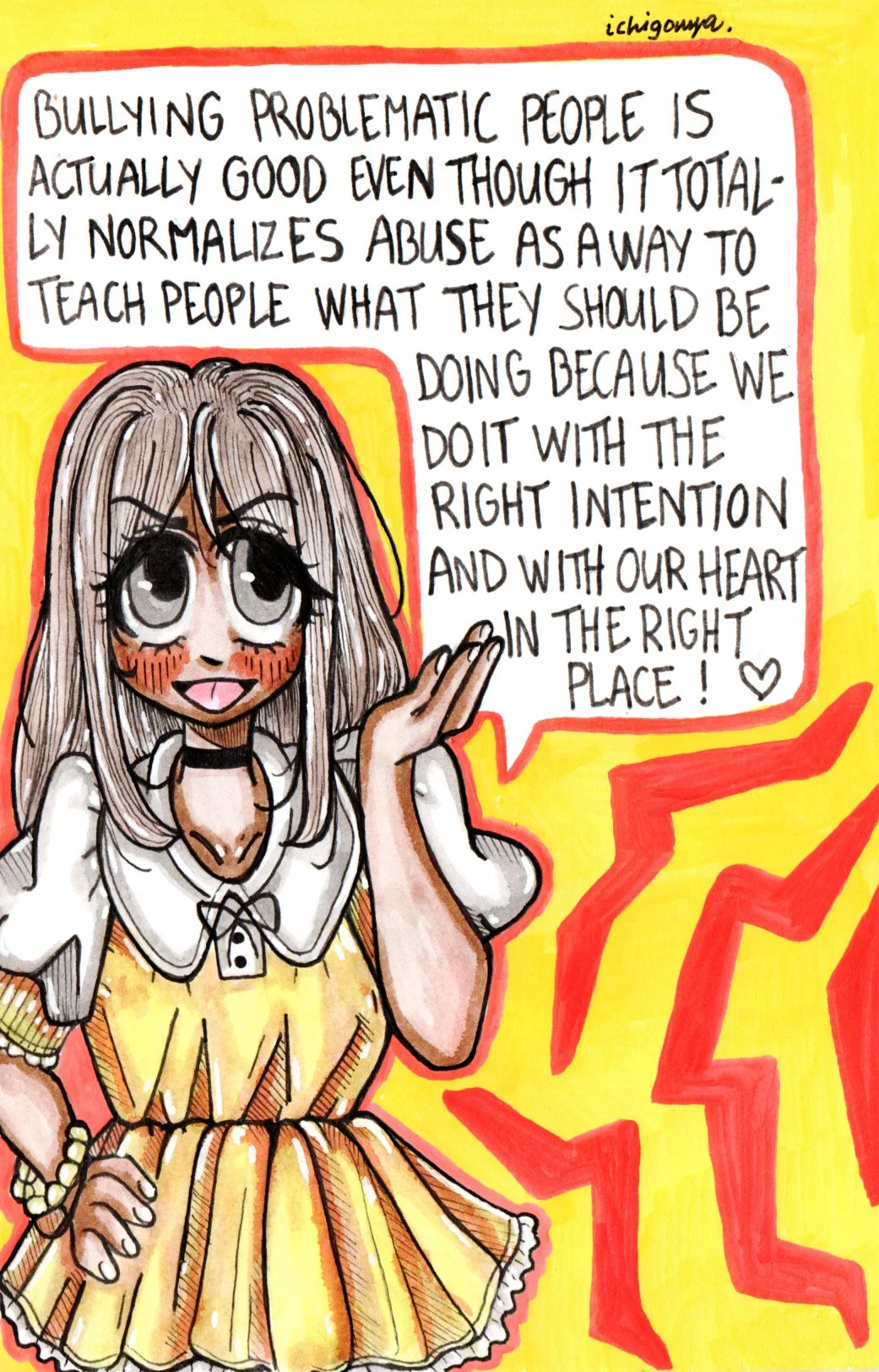
The Internet is a fascinating place: it’s where nuance goes to die, and black-and-white thinking is celebrated like the second coming of Christ. It is the perfect breeding ground for polarized thinking that is inherently dangerous, no matter what end of the spectrum you happen to be on. One of the ways this pandemic of lack of nuance is affecting us in the online world is how we fight to justify abuse of any kind by coming up with roundabout arguments that very often have something to do with what kind of person the target of the abusive behavior happens to be. There is one very topical example of this phenomenon that I decided to make commentary on around two weeks ago, and it continues to be the point of reference for this article as well.
The normalized usage of generative AI programs.
Now, I would like to prefice everything I am about to say with one disclaimer: here, AI only serves as an example of the mentality of justifying abuse on the Internet. This article, illustration, or the YouTube video I have attached to this text is about the mental gymnastics of normalizing abuse when it benefits us personally, not about the problematic nature of generative AI. For commentary on AI itself, I would encourage you to seek out other artists, content creators, and authors instead of me.
You can watch the speedpaint of the illustration present in this article and listen to me talk about why bullying people for using AI is not the woke friend thing to do on my most recent YouTube video. View the video in the embed below, or click this link to watch it on YouTube separately.
This conversation starts from the observation that some bullying, particularly when it’s targeted toward a group of people who do something morally dubious or otherwise generally frowned upon, is productive and useful. People who agree with this sentiment feel like it is okay to subject certain types of people to abusive behavior, because they want to teach that group of people a lesson on how to behave and be “like the rest of us”. On the surface level, this mindset might seem okay and something to strive for, but at the core of it all lies the big problem that gets overlooked and ignored. That major problem is something that I have over the years decided to call “the culture of bullying”.
activist.
The culture of bullying refers to the social norm that we as human beings have established to direct ourselves into attacking people that seem out of the ordinary, not part of the group, who are seen as threats to the safety of the group by various arbitral standards. Usually, the subject of this treatment is the weird kid in class who doesn’t seem interested in adhering to the norms of the community they have been forced to be a part of, and that group, meaning the class, views this behavior as something worth terminating and ostracizing the weird kid for. Their presence in the group is not needed nor desired, it serves no purpose to the group that is too hung up on social norms that don’t do anything except for teach us how to conform, so the kid gets abused for it. Granted, this is only one side of the complex nature of bullying as a form of abuse, but it is the most relevant for the discussion at hand.
It is not just the weird kids in class who end up being victims of the culture of bullying, though. Later on in life, the targets can change, depending on what social group we are engaging with, and based on what standards the group is judging its members and outcasts. To pull out another example, it is fairly common to see members of the alternative community engaging in abusive actions toward so-called “normies”, meaning the regular folk whose aesthetics, fashion, or lifestyle conforms to those of the general public. When observing the alternative community as the primary group of reference, “the normies” are the weird ones who get ostracized from the community, even if they have similar interests to those who belong to the alternative community. If you don’t dress alternatively enough based on the social norms of the community, your status as a member gets questioned and you easily become the target of harassment. The point of reference changes, meaning what is considered out of the norm and in compliance with the social norms of the group, but the phenomenon stays the same.
Now, when it comes to the users of generative AI, they are seen as the outcasts of the general public, at least when we’re observing the situation from the perspective of the online world. AI users get trashed left and right whenever they bring up their interest in the technology or share anything they have used it for. The Internet is as of right now primarily anti-AI because of its devastating effects on the creative fields as well as the environment and climate of this planet. People who still choose to engage with generative AI get treated exactly the same as the weird kids in class who behave in ways not deemed acceptable in their community, the classroom. For the sake of being a devil’s advocate, I do want to point out that many AI users are aware of the damage they are causing by engaging with the programs but choose to do it anyway. This is comparatively different than, for example, the autistic children who get abused by their neurotypical friends, because they are not aware of why what they are doing is seen as “wrong”. However, I think it’s absolutely imperative that we take a step back and focus on the word “bullying” itself again, because a lot of the discourse online has diluted the meaning of the word, and knowing me and my mission, this is an issue that has to be solved before we go any further with this reflection.
Bullying is a descriptor of abuse that refers to a wide spectrum of abuse tactics that have four things in common: they involve a group setting, power imbalances between the group members, the abusive behavior is systematic and repetitive, and it is directed to a specific individual. Bullying is not criticism, it is not holding people accountable for their actions, it is not questioning authority, it is not educating, it is not humoristic, it is abuse. If you use that term, I am always going to assume that you know what you are talking about, that you’re using bullying as a descriptor of abuse instead of some buzzword that seems slightly related to what you’re actually trying to say. If this is not the case, do not use a descriptor of abuse. If your argument is that we should openly criticize people for using generative AI, say that instead of calling it bullying. We need to know we are talking about the same thing, and unlike many people assume, bullying is a word with a very cut-and-dry definition that needs to be respected. It is for the protection of victims, and for the benefit of everyone else involved.
Some people argued in the comment section of the carousel post I made on this topic that this issue falls under the label of the paradox of tolerance. Paradox of tolerance is a philosophical concept suggesting that if society at large extends tolerance toward those who are intolerant, we risk normalizing intolerance and therefore fail to achieve the eventual goal of tolerance. My opinion is that using it as an argument for abusing those who use generative AI is a misconstrued understanding of what intolerance means. Using generative AI is not a form of oppression or discrimination, and these two are the most common examples of the paradox of tolerance.
To me, being anti-bullying and anti-violence will always be the most important value of my work. You don’t have to agree with me on that as we all have personal understandings of these matters based on our individual experiences and the like. Violence has never solved anything for me, and as an anti-bullying activist, advocating for abuse of any kind is in direct contradiction with my principles on why even do what I do. By advocating for violence toward those we deem “deserving” of it by some arbitral standards, we are contrubuting to the culture of bullying and reinforcing it as a method of “teaching people how to behave normally”. Maybe it’s just because I was brought up by two academics, but to me, educating will always be the primary way of teaching people anything, no matter the cause.
You will never see me fight for the right to bully anyone. I don’t think that makes me a better person, it’s just a personal value I will always hold onto. You shouldn’t expect that to change, no matter who we are up against. Stopping the cycle of abuse is way more important to me than being right.
Pondering,
ichigonya