“My Own Bully”
The Internet is amazing at separating words from their actual meanings. It feels like every week, there is a new buzzword floating around the online world, a word that has been co-opted by a community of sorts to describe something that bears no resemblance to the original definition. Over the years as I have worked on this project and analyzed online discourse, I have noticed that ‘bullying’ and all of its variants are a regular victim of such behavior, and for reasons I shouldn’t have to explain at this point, I find issue with that.
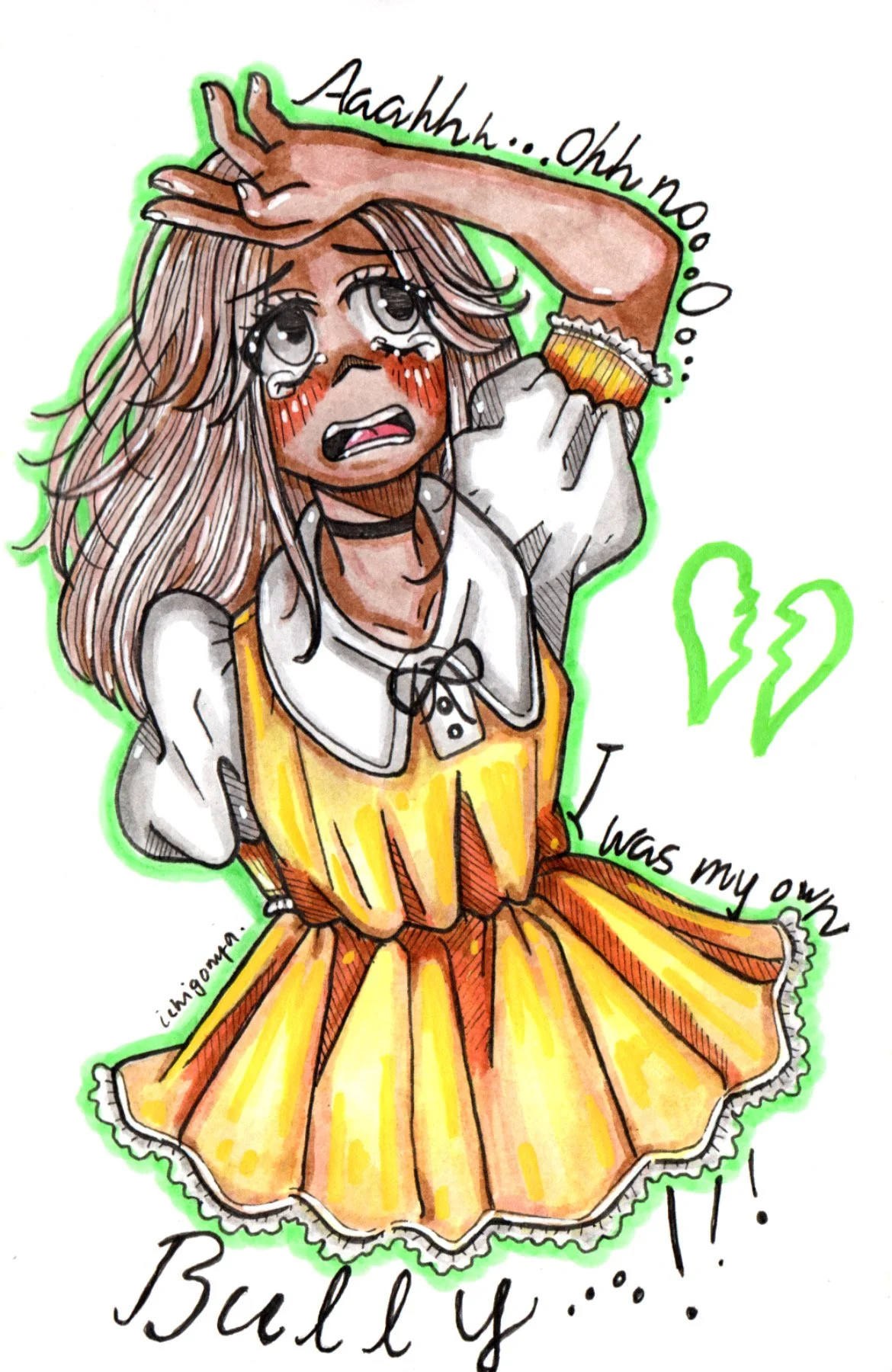
One particularly infuriating version of this appropriation of the word is Internet users describing themselves as “their own bullies”.
You can watch the speedpaint of the illustration present in this article and listen to me talk about the nuanced problems with appropriating ‘bullying’ to describe your self-esteem issues by watching one of my most recent YouTube videos. View the video in the embed below, or click this link to watch it separately on YouTube instead.
A lot of the times when I criticize the Internet for using the word ‘bullying’ incorrectly, people have accused me of purposefully misinterpreting what is actually being said in order to make a point. While I understand where this argument comes from, I would argue that it does nothing but deviates the attention from the very valid reasoning for the criticism. These conversations are not about intentions, but instead about the power language holds over us as human beings, because it affects the way we perceive and conceptualize matters it refers to. This is something I learned in my years at uni, studying linguistics. There is a very real and appropriate reason for criticism toward the way language gets abused by the Internet, because no matter if you believe it or not, its impactfulness reaches beyond the point of the online world.
drama queen.
What people are trying to say when they call themselves “their own bullies” is more than likely related to self-esteem issues, lack of self-confidence, and being your own worst critic. How the word ‘bully’ makes its appearance in this scene is by the association we commonly have to bullying as a type of abuse: the popular kid in class who everyone likes but who actually hates themself and projects that self-hatred onto the weird kid who chooses to remain true to themself and has nerdy hobbies. People who don’t have personal experiences with bullying, who haven’t dedicated their entire lives to understanding that specific type of abuse don’t think about it too deeply but instead go for the stereotypical and cliched interpretation, using it to serve for the point they want to make. And who am I to judge them? I wish I didn’t know as much about this shit as I do, either.
But that doesn’t take away from the fact that this kind of constant misuse of the word does harm to the real meaning, and therefore it has an impact on the victims and everyone else involved in situations of bullying. When we start to describe our self-esteem issues with language that is meant for literal abuse, we are stepping into the territory of constant trauma invalidation and victims being neglected in their traumas. We should be able to talk about personal issues with poor mental health without appropriating a word that is already so greatly misunderstood.
With any other type of abuse, this kind of language would not be as normalized. What makes bullying so insignificant to people that we allow others and ourselves to misuse to this extent? What is it about bullying specifically that does not require us to treat it with the seriousness of an abuse form? Could it possibly be the fact that each and every one of us has and still continues to benefit from the culture of bullying, even when we have been victimized in the past? Think about the last time you saw someone doing something weird or cringy on the Internet. Did you feel the urge to leave a snide comment about the way the person looked, about their strange behavior? Did you try to justify it to yourself by thinking of the differences you had with this person; “I’m not bullying them, I’ve been bullied too, I just think they need to be told that their dancing looks stupid because of how overweight they are”?
What I’m trying to say with all of this is that even those of us who consider ourselves to be anti-bullying often find ways to diminish bullying as a type of abuse, especially when it benefits us personally. The phrase “I was my own bully” is filled with self-pity and self-victimization but also self-righteousness. It’s meant to evoke feelings of compassion and understanding, but it also positions the person themselves above what bullying is actually about, because no no, this is not about the real deal even though I’m using the word in a context that could imply some type of abuse dynamic but since that abuse dynamic cannot exist when only one person is involved, this is not about bullying at all. I’m just personally benefitting from the concept of bullying and trying to make others feel bad for me, just like they would feel bad for an actual victim.
Maybe this is all too much and completely pointless, but you cannot stop me from having this issue with language like this. Sometimes I still feel like I carry the badge of a language policeman, like I used to in my student overalls about five years ago. Or maybe this is just a resurrection of that part of myself, who knows. Until I figure out the answer, please humor me for a while.
In frustration,
ichigonya