When Words Really Hurt You
In this CHAPTER, we have talked a lot about the various types of cyberbullying, especially ones that extend their limits outside of the regular hate comment. It is true that online abuse comes in many different shapes and sizes, and simplifying this very complex and nuanced issue into just mean comments and messages is doing a disservice to the overall mission of anti-bullying advocacy. However, before drawing this CHAPTER to its conclusion, I wanted to spend some time talking about the ways in which words people say to you online can, actually, be so much more damaging than we give them credit for.
At the core of my work has always been my intention to protect the children from the kind of abuse that traumatized me to the point of me developing multiple mental illnesses and other chronic illnesses. Even though the story is personal to me, my art and activism has a greater purpose than to just offer me a venting ground. This distinction should become apparent when you observe my illustrations depicting the abusive events I have gone through in my life and notice that instead of Ichigonya being the character present, it is always, without a doubt, The Kid. Because it is The Kid and her suffering that has brought me here, both in terms of creating art in general and of me writing this article right now. Without The Kid and her past, I wouldn’t be here—and so, by extension, everything I do and make becomes about the Kids all around the world. This isn’t about me, this is about the Kid I once was and about all the Kids who have gone through and still go through the same horrors I did.
You can watch the speedpaint for the illustration present in this article and listen to me talk more about the way children are particularly vulnerable to online abuse and trolling by watching my most recent YouTube video. View the video in the embed below, or watch it directly on YouTube by clicking this link.
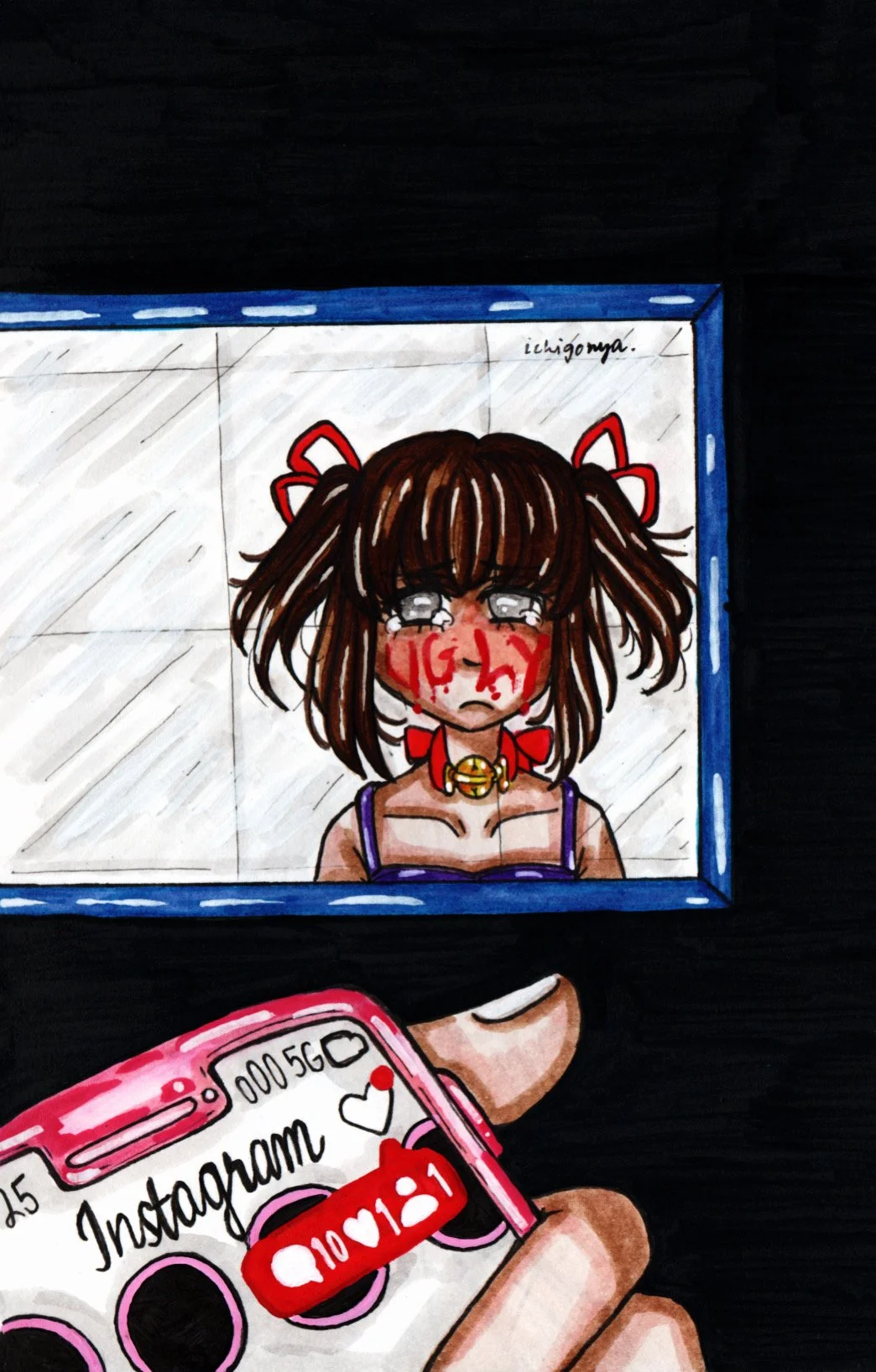
comment.
When we talk about cyberbullying/online abuse, typically we imagine the victim being an adult for one reason or another. We think of the social media content creator, YouTuber or blogger who has chosen to put themselves into the online world in a very visible manner and are then talking about the hate they receive for creating the content they do. This mental image, while not completely unfounded, is a misunderstood conceptualization of what cyberbullying is even about and who it affects the most. For the sake of my argument both in the video mentioned above and in this article, I am going to focus on the way children are at the forefront of potential victims of cyberbullying and how strongly it can affect their well-being.
For adults, being a target of online abuse might be easier to deal with, because adults are able to filter through words they hear about themselves easier than children. This is simply due to adults’ lived life experience and the more advanced developmental stage of their brains. For a child, every comment they get is another moment of being evaluated as a member of a community. Each word that gets said about them becomes a valid point of feedback for them to consider in search of finding who they truly are as a person and what kind of role they have in their community. The Internet is a massive global community that many children find friends and other likeminded kids in, to connect and spend time with. So every comment they receive is a direct evaluation coming from the community itself, and its validity becomes that much higher. This is exactly why it is more difficult for children to deal with hate comments, whether they’re coming from bullies or trolls.
⋅•⋅⋅•⋅⊰⋅•⋅⋅•⋅⋅•⋅⋅•⋅∙∘☽༓☾∘∙•⋅⋅⋅•⋅⋅⊰⋅•⋅⋅•⋅⋅•⋅⋅•⋅
For the purpose of comparison, let’s imagine a situation for ourselves here.
You’ve recently been hired for a dream position by an employer you really respect. You’re an adult in your thirties, you’ve had a lot of working experience in the field of your choice, and you’ve finally progressed to the stage where applying for that dream job was possible for you—and you got the job. You start working at the company, begin to know your co-workers, and everything seems to be going pretty swimmingly. You’re making connections, and the community has accepted you as a valued member, and after working so hard to be where you are, you feel proud of yourself.
Then, one day, you hear from your supervisor that the founder of the company wants to talk to you personally. You have looked up to this person for a long time, and to get a personal invite to meet them is another dream come true moment. Your supervisor takes you to the founder’s office in a floor you’ve never been allowed to enter. They open the door for you and say goodbye, wishing you luck. You step inside the office with your heart beating in your chest out of excitement, until you finally see the founder of the company in front of you. They have a disapproving look on their face, and your stomach drops.
For the next fifteen minutes, you are forced to listen to the founder spit out an inflammatory lie after another, painting your character in an entirely fabricated manner. Your co-workers who have been acting nothing but nice to you have made several baseless HR reclamations on you, and they have reached the founder of the company. This person who you’ve looked up to for years is bastardizing your character and possibilities of ever working on the field again. Your reputation is forever tarnished, and you’re forced to pack your things and quit the job after doing nothing wrong.
⋅•⋅⋅•⋅⊰⋅•⋅⋅•⋅⋅•⋅⋅•⋅∙∘☽༓☾∘∙•⋅⋅⋅•⋅⋅⊰⋅•⋅⋅•⋅⋅•⋅⋅•⋅
In this imagined scenario, being upset over the fabricated lies, mischaracterization, and the loss of a job for something you didn’t even do would all be completely justified, and anyone who tries to argue with that would most likely face some type of scrutiny for it. This made-up scenario is also based on the same pattern of behavior that we see in instances of bullying among children all the time. The only difference is that for adults, the stakes are higher in a concrete manner (like losing a job). But the emotional damage that a child sustains when faced with character assassination online is of the same caliber than that of the adult, because for the child who has only been on this planet for a couple of years, this is one of the worst things that could happen to them. The prospect of losing all of their friends, being expelled from school, not being allowed to practice their hobby, is a similar kind of loss than the adult facing the risk of losing their job.
Words aren’t just words when you are a tiny human being, just learning how to even live life. They become daggers that stab you in the back while you are forced to pick up the pieces without letting a single tear fall down your cheek, because honey, you should already know that they’re just words on the screen.
Deleting Facebook,
ichigonya