Pills For The Empty Nights
Mental health is a complicated facet of the human existence. You can’t treat it as its stand-alone part of health, but you have to remember that conditions affecting one’s mental health are also something to be considered in physical health. Many psychiatric illnesses also have an impact on the way you feel on a somatic level, and since the brain is an organ that can get sick just like any other organ, it makes sense that there are medications out there to help with the mental anguish caused by the illnesses of the brain.
I have always been a huge advocate for medication. Antidepressants have saved my life more times than I can count; going to the ward for me has always been about my depression worsening to the state of me actively seeking out ways to kill myself, but the new antidepressants, whether it’s a completely new pill or a changed dosage of the already existing one, has been the solution for that specific issue. I was 17 years old when I was first put on antidepressants, and that has continued to be the case ever since then. The stigma for psychiatric medication is still very strong in our society, and I want to help the issue by talking about my experiences with that specific type of medicating of my illnesses in a positive way.
But as is the case for almost all things in life, there is a downside to this topic, too.
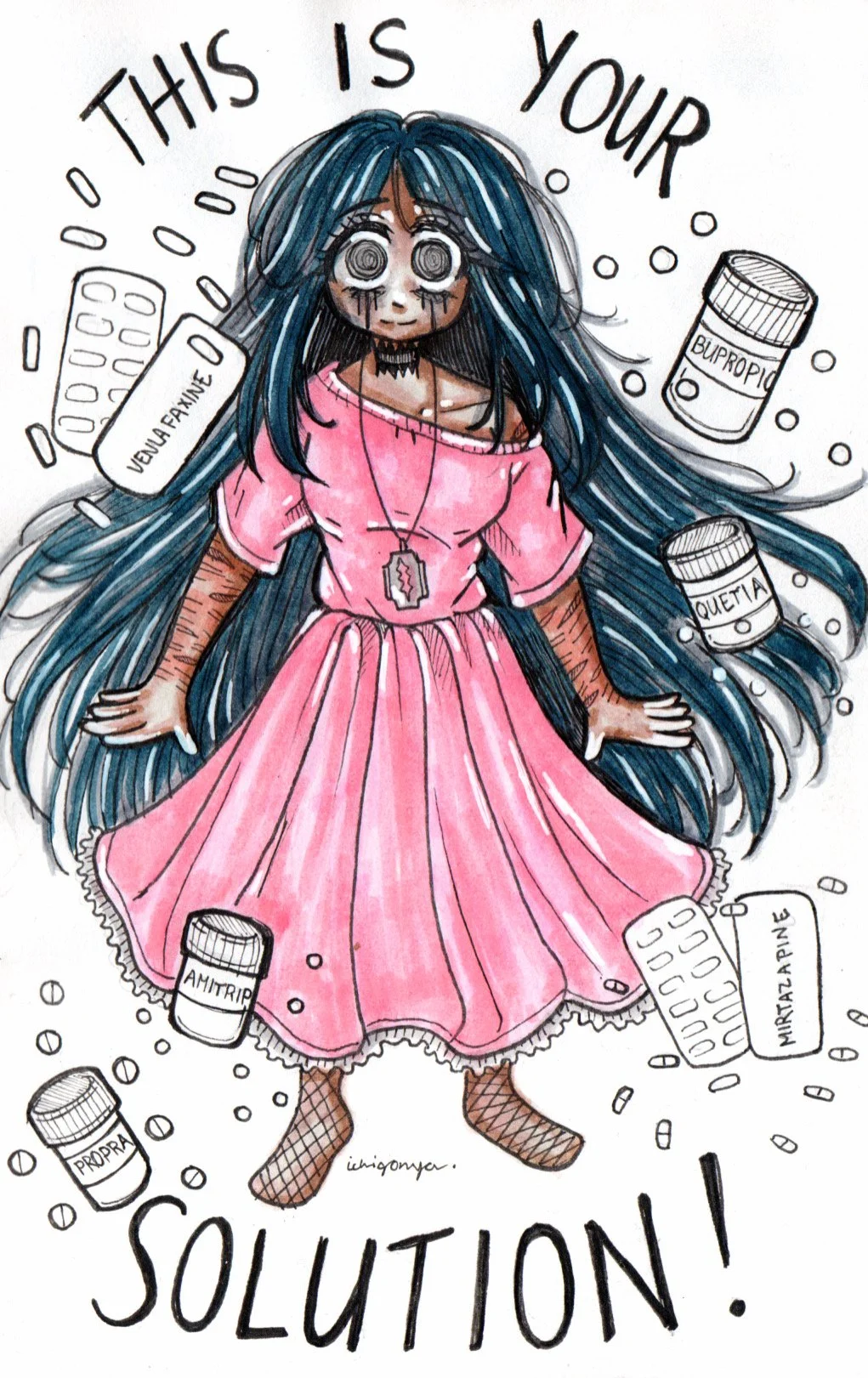
solution.
Last autumn when I was in a deep depressive episode and in the look-out for any possible way to help myself feel better, I was offered multiple changes to my then-existing medication. At the time, I had been on the same pills for several years, one of which was the very first antidepressant I was prescribed at 17. I hadn’t felt like the meds had been helping me for a very long time, and with the way things were going in September, I could just tell something needed to be done. I had already brought up my desire to change the medication entirely several months prior, but nothing had been done. Then, as my situation escalated day after day, I was in a state where an intervention was needed. But like discussed in previous articles of this CHAPTER, no stay at the psychiatric ward was offered to me, because apparently “that was not the way someone like me should be treated”.
On one of my many visits to the ER, I was given the chance to talk to a psychiatric nurse. I explained my willingness to do anything with my medication, apart from changing the doses to my already-existing antidepressants, because they had just not been helping me for several months at the time. The nurse consulted a doctor, not a psychiatrist, and they came to the conclusion that upping the dosage of my two major antidepressants was what I needed. I did not want this.
The visit to the ER was extremely frustrating. None of the medical professionals wanted to even entertain the idea of me being hospitalized, even though I told them I had a detailed plan to commit suicide. In the state I was in, I got incredibly frustrated and balled my eyes out, screaming about how nobody was helping me find any type of solution to the crisis at hand. That’s when the general practitioner who had had the idea of upping up the dosage of a pill I had been on for almost ten years said this to me:
“We just changed some of your medication. I think that’s as good of a solution as any!”
The problem was not the dose of the medicine. The problem was the pill itself, because it had stopped working for me for almost half a year prior. This is very common with antidepressants especially when you use them for a long period of time: the effect of the medication wears out because your body has gotten used to the chemicals, and it has no impact on your depression anymore. Changing medications in the field of psychiatry is commonplace, but for some reason, these medical professionals were completely against the idea.
Medication is not the end-all-be-all solution to many psychiatric conditions, especially ones that are traumagenic like mine. Medication can help alleviate the worst of the depressive symptoms, but it will not solve the problem of the trauma that caused those symptoms to appear in the first place. And when it comes to severe suicidality and actual plans to kill yourself, simply changing some of the doses of the pills you’re on without taking you into an environment that would protect you from yourself is an active practice of medical neglect. Leaving the suicidal person to their own vices and just hoping that they won’t attempt is not proper mental health treatment.
Take your meds if you need them, they’re important. But don’t forget to fight for your right to receive proper treatment when you are really struggling, whatever that treatment may be. Fortunately for me, after several weeks of arguing back and forth with the medical staff, I was able to get the needed change to my medication. It didn’t remove my trauma, but it sure as hell helped me feel better enough for me not to actively plan a self-exit out of this world.
Give me all you got,
ichigonya