Open Your Eyes
Working on this CHAPTER has brought back a lot of memories of being neglected by the system, both the educational and the healthcare. Granted, that is what this story has been about for the most part, but that knowledge doesn’t take away from the Pain of being reminded how fucking difficult it has been to just, you know, be noticed and helped like I’ve needed to be. But I think at its very core, this feeling of being let down systematically by those who were supposed to protect me really focuses on the way teachers and other educators have decided to completely shut their eyes from the abuse.
Over the years I’ve been working on the project, I have received a fair amount of questions regarding how I think teachers should handle situations of bullying. There is a lot of frustration and even resentment coming from those working in the educational field, because at large, people in schools feel like their hands are tied behind their backs, and that they are not being given the chance to even help the suffering Kids. I think this reaction is a very human one and definitely not something I am blaming the teachers for. At the end of the day, there is only so much that you as an individual can do in a faulty system.
But what I do feel like gets unnoticed and misunderstood a lot of the times in these conversations is the fact that if you, as a member of the group in charge, give in to the limitations without any fight, no change will ever be accomplished. For the sake of comparison, you could think of the way marginalized communities have been able to fight for their rights throughout human history, and how it all started with a few individuals questioning the status quo. No queer rights would have been accomplished without the inherent danger of fighting against the oppressive cisgendered and heterosexual norms of society. In the same vein, no change for the better and for the safety of the children in schools will be achieved if we choose to remain complacent.
On one of the articles I wrote for this CHAPTER, I received this comment from a teacher, asking me to share them my advice on how teachers and other educators should handle situations of bullying, from the perspective of a victim.
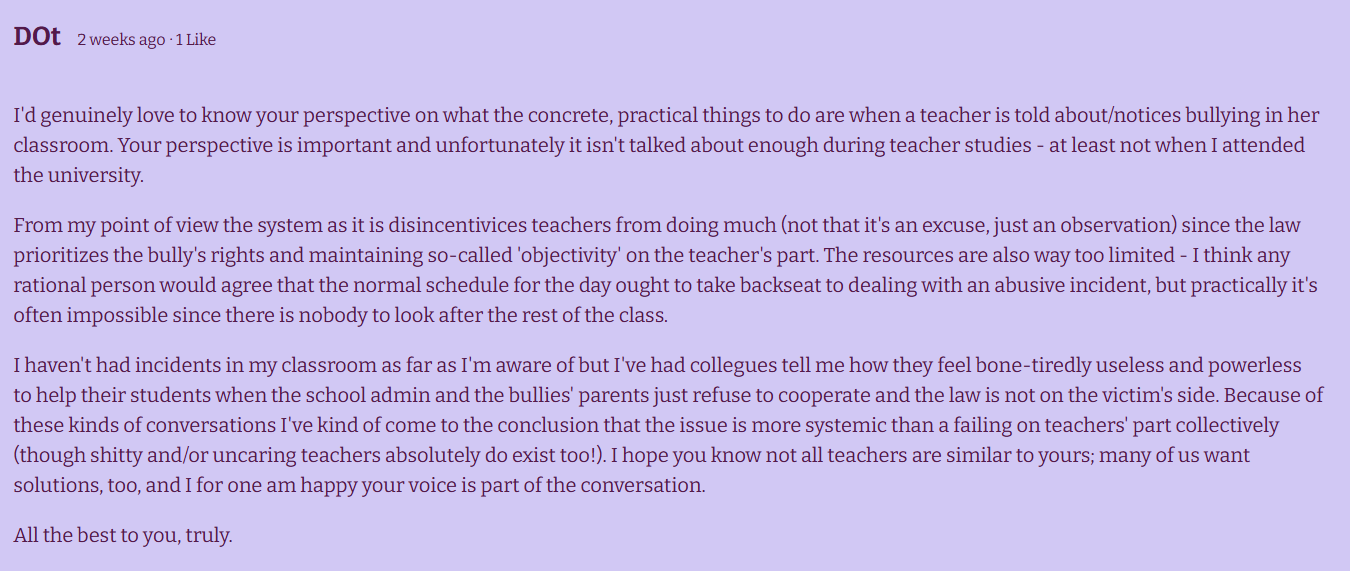
I think this comment highlights the way teachers at large tend to feel about bullying: it’s a problem they’re all aware of, but they’re simply not prepared enough to do anything substantial about it. That is, usually, not their own fault, as this particular teacher so eloquently argues in their comment. It is a result of multiple factors, most of which are out of the control of singular teachers. And I definitely have sympathy for the teachers who have been given the short end of the stick and are then forced to witness abuse taking place in their classes.
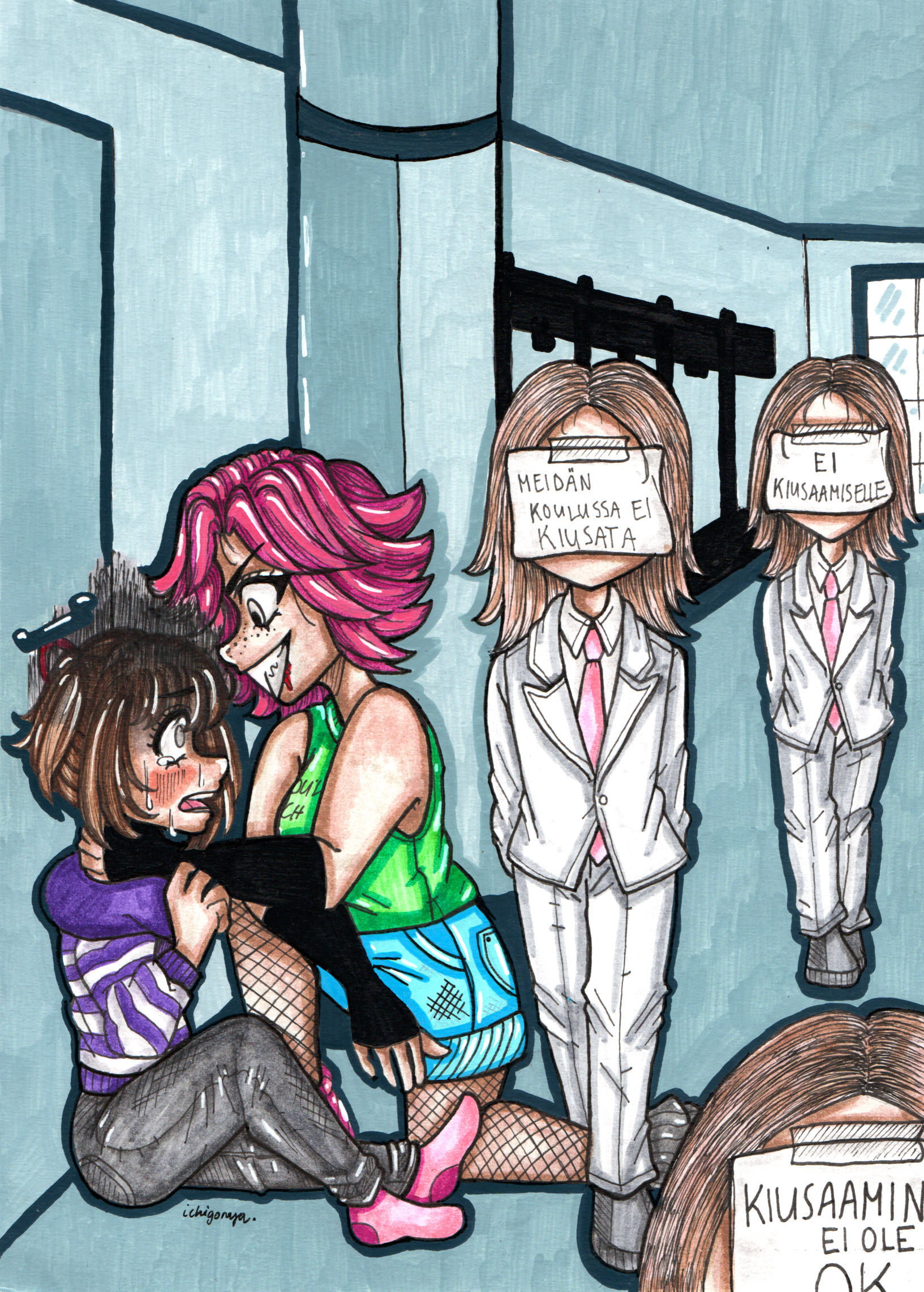
käytävä, corridor.
However, for someone like me who has not only had extensive experiences with this type of abuse but has also done their fair share of reading on the scientific backing of anti-bullying solutions and programs, some of these arguments do end up sounding somewhat similar to what the so-called “silent bystander” in bullying roles thinks and does.
The silent bystander is someone who is aware of the abuse happening usually in their own class, very often is not associated with either one of the parties, but does nothing to help the victim, or to aid the abuser for that matter. They have become someone who accepts the abuse without doing anything concrete to aid it, but also without doing anything to stop it. Most kids in school settings in particular fall under the category of the silent bystander if there is bullying taking place in their classes, generally out of fear of becoming the next victim of the abuser. Teachers can also become silent bystanders, and in instances where bullying has become sort of a norm in the school environment, almost like a culture of its own, more and more teachers fall under this category, as well.
The notion of “there is nothing we can do about it, we have too much stuff take care of it as it is” is a very reasonable explanation to this kind of mentality, particularly in schools where a lack of resources is already at place (in the form of low staffing, for example). But if this mentality becomes the most common way teachers react to situations of abuse among their students, a paradox of actually available resources versus the resources being used can occur.
Let me put it this way.
Say you have an assignment due for school or university in about a week. You haven’t started working on the paper, and as the due date inches closer, you start to panic. You look at the calendar one day, and boom, the essay is due in three days. You go over the assignment once more and refresh your memory on the requirements of the paper: three pages of text on Google Docs, font size 11, line width 1,5. You know you are a good and fast writer, you’ve been able to complete papers in one sitting if needed. But the topic of this assignment is a bit foreign to you, and you’re not feeling all that confident in your writing capabilities. You start to think, “this is not enough time for me finish, three days is nothing for all of this work”. The anxiety wells up inside you, and you stare at the blank document file on your screen for hours on end, freaking out and telling yourself “I can’t do this”. The three days go by, and you fail to turn in the assignment in time. On the next lesson or lecture, you go up to the teacher to explain the situation, and they look at you confused and then ask,
“You’re one of the best writers on this class, and you had a week to complete the assignment. How was that not enough for you?”
What I’m trying to get across with this comparison is that if you have the presupposition that something will not go right, or that you don’t have enough time/resources to do what is required of you, the likelihood of you failing at the task gets higher. Attitude is not everything, but it does matter in the context of completing tasks like assignments, or taking care of responsibilities, like protecting kids from abuse at school.
The comment I shared earlier was a very pleasant one, and I wanted to give the person a detailed response. Here is what I wrote back to them.
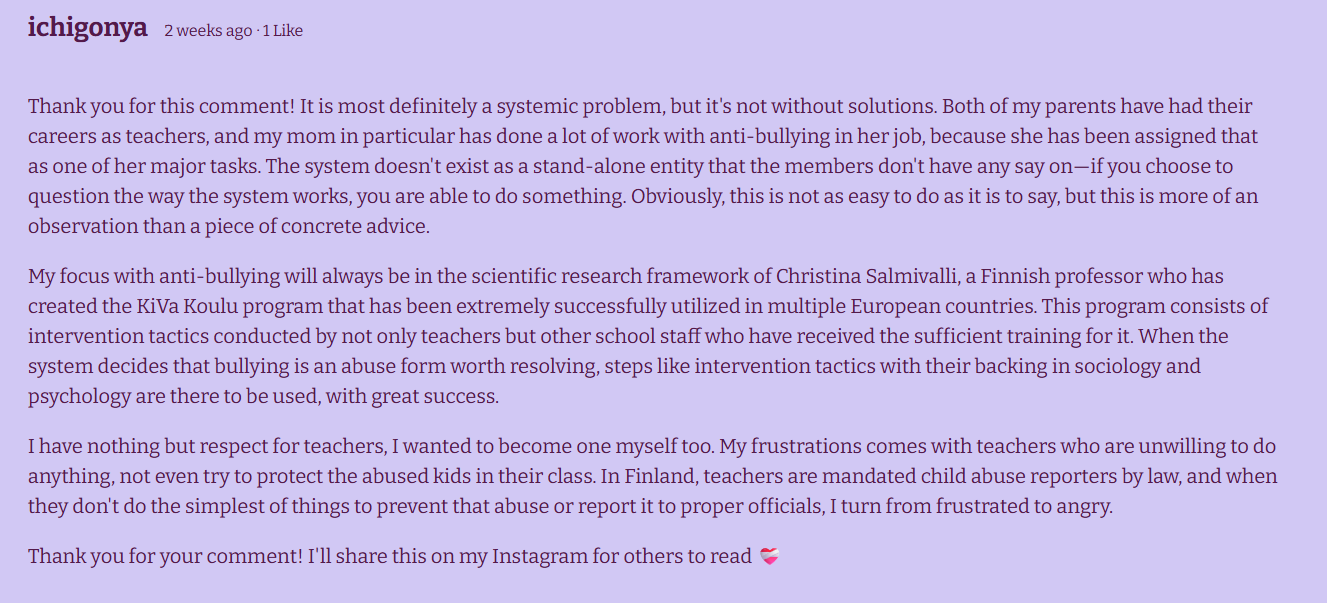
Systemic changes are difficult to initiate when you are nothing but one cog in the machine, that goes without saying. But the responsibility cannot be put on the system alone, as we all take part in it in some way. If the culture of bullying in schools gets questioned by individual teachers who are filling to fight for the safety of their students, changes are more than possible, and there are already methods out there waiting for you to use in that moment.
Education systems are underfunded all around the world, even in Finland thanks to the politics of the current right-wing government. The fact of the matter is that, at the end of the day, methods such as the intervention tactics present in the KiVa Koulu program have been utilized to eradicate abuse from schooling environments in various countries. Anti-bullying programs are a group effort, something each member of the team (a school, for one) has to sign up for and then show up for in their actions toward the greater good. The change is not an impossible one.
You just have to open your eyes to see it.
Faithfully,
ichigonya
⋅•⋅⋅•⋅⊰⋅•⋅⋅•⋅⋅•⋅⋅•⋅∙∘☽༓☾∘∙•⋅⋅⋅•⋅⋅⊰⋅•⋅⋅•⋅⋅•⋅⋅•⋅